

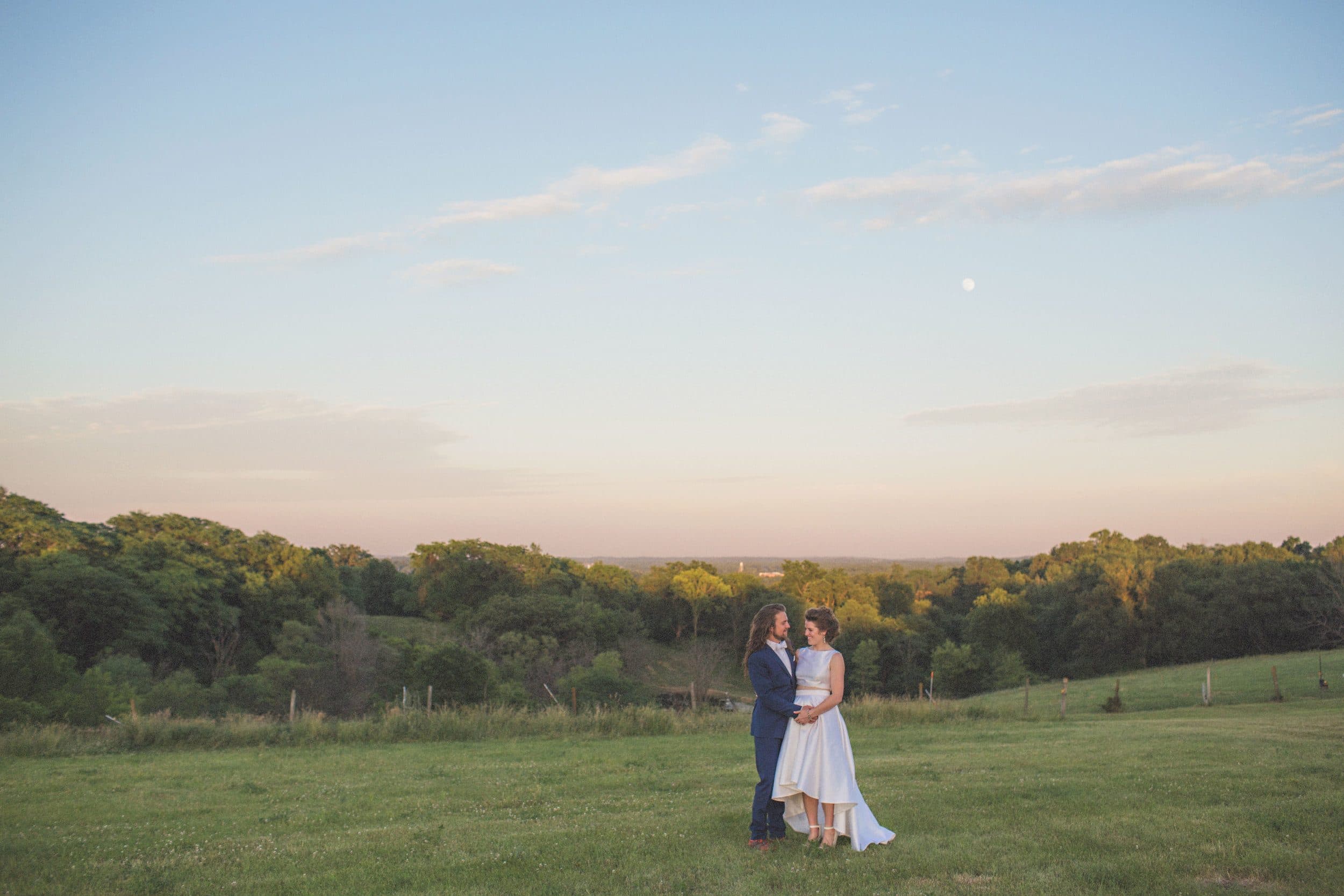
Getting married on the family farm.
The most meaningful wedding I photograph is almost always on land somebody's family has farmed for three generations. It is also the one with the most ways to go wrong, because there is no venue staff standing between you and every detail.
A venue is a hundred invisible decisions somebody already made for you. On a farm you make every one.
Where cars park and who directs them. Whether the septic handles a hundred and fifty people. Whether the power holds a band, a caterer and the lights at once. Where the trash goes. Who mows, and when. None of that is hard, and all of it is yours. Couples who understand that in month one have the best day of anybody I photograph. Couples who discover it in the final week spend that week in a panic instead of with their families.
Septic and water are the real capacity limit
A farmhouse septic system was sized for a family, not for a hundred and fifty guests over six hours. This is the constraint that decides your guest count, and almost nobody thinks of it until a plumber is on the phone the week after.
The answer is portable restrooms, and the good ones are not the ones at a construction site. Trailer units with lights, sinks and climate control exist and they cost real money in the peak of the season, which means you book them early. Plan a 10 by 10 foot pad per unit, at least 25 feet from any tent, screened from the reception with fencing or plantings, and reachable by a service truck.
Check the well too. A hundred and fifty people plus caterers washing hands and rinsing pans is a load a rural well may not be sized for, and the day you find out is not the day you want to find out.
The power will trip. Plan for it.
A working barn typically runs a couple of circuits meant for a light and a compressor. A wedding wants a band or DJ, catering warmers, coolers, a coffee urn, and string lights across the whole yard. Something is going to pop, and it is usually during dinner or the first dance.
Get a generator, and place it at least 30 feet from any tent on flat, dry ground with a clear exhaust path. Then place it further away than that from where people will sit, because a generator running behind the barn all night is audible on every speech in your video.
Have the tent company make a site visit before anything is ordered. They will check for power lines overhead, sprinkler lines, the septic field and anything else that a stake driven three feet into the ground can ruin.
Insurance and permits, the boring part that stops a wedding
A one day special event liability policy runs about $175 to $400 depending on limits and guest count. Buy it. Most caterers will not sign a contract without proof of it, and if somebody is injured on your family's land, the alternative is your parents' homeowners policy.
Tents over a certain size need a permit in many jurisdictions, and once one is up a fire marshal may inspect for marked exits, extinguishers and enclosed flames. Portable restrooms can require a health permit. Amplified music past a guest threshold or a certain hour can require a noise or special event permit.
Every Iowa county handles this differently, and the office you want is the county health department or the county building department. One phone call in month one costs you twenty minutes. The same call in the final week can cost you the tent.
Mud is the thing that actually ruins farm weddings
Rain on a farm is not the same problem as rain at a venue. A venue has a parking lot. You have a field, and a hundred cars, and a spring that has been wet for two weeks. I have watched a wedding start forty minutes late because three cars sank in the same soft spot near the gate.
The plan has three parts. First, a firm surface for parking: a mowed hayfield drains and holds far better than a low pasture, and gravel near the gate is worth the load of rock. Second, somebody with a tractor and a strap on site, sober and available, whose entire job that day is pulling cars out. Third, a decision point: at what forecast do we move the ceremony under the tent, and who makes the call and when.
The couples who write that down in April never think about it again. The ones who do not spend the morning of the wedding refreshing a radar app.
Mow early, and know your field
Cut the grass two or three days before, not the day before and never the morning of. Fresh clippings stick to shoes, hems and dress trains, and a field mowed the same morning is still damp and green enough to stain white fabric.
Walk the ceremony site at the exact hour your ceremony will happen, a week out. Where does the sun sit? Are your guests looking into it? Is there a hum from a grain dryer or a road? Are the cattle in the near pasture that week, and what does that mean for smell and flies in August?
Then walk the field where portraits will happen at sunset. The best light on a farm is almost always low sun across an open west field with the barn behind you, and knowing exactly where you will stand saves fifteen minutes of wandering at the moment those minutes matter most.
What the farm gives you that no venue can
Everything above is the price. Here is what you buy with it: photographs made on ground your family has worked, in buildings your grandfather built, with the same horizon behind you that has been behind every family photograph for sixty years. No rented venue can manufacture that and every couple who has it knows it.
You also get time. Nobody is turning the room over at ten. Nobody is running two weddings that weekend. The day can breathe, run long, and end around a fire instead of at a hard stop, which is where the loosest and best photographs of the whole day usually happen.
And you get the day before and the day after. Setup with cousins, a rehearsal in the yard, breakfast on the porch. At a venue that is three separate rentals. On a farm it is just a weekend at home.
What a family farm wedding actually costs
| Line item | Range | What to know |
|---|---|---|
| Venue fee | $0 | The reason people start down this road. Everything below is what the venue fee would have covered. |
| Tent, sides, lighting, flooring | $1,500 – $8,000 | The big one. Sides and flooring cost real money and you want both if the forecast turns. |
| Tables, chairs, linens, place settings | $2,000 – $5,000 | Same as a barn: nothing is in the building already. |
| Portable restrooms (trailer units) | $800 – $3,000 | Book early for peak season. The nice ones with sinks and climate control sell out. |
| Generator and power distribution | $300 – $1,200 | Not optional. Farm circuits will not carry a wedding. |
| Event liability insurance | $175 – $400 | One-day policy. Most caterers require proof before they will sign. |
| Ground prep: mowing, gravel, a tractor on standby | $200 – $1,500 | Cheap insurance against the single most common farm wedding disaster. |
| Coordinator | $1,500 – $3,500 | More necessary here than anywhere. On a farm, the coordinator is the venue. |
A farm wedding is rarely the cheapest option and it is frequently the most meaningful. Once tent, rentals, restrooms and power are counted, many farm weddings land close to what a full service venue would have charged. Choose it for the land and the time, not to save money, and you will be happy with the math.
What I would tell you on a tour
The west field at last light is the whole reason
Every farm I photograph has one direction where the light comes across open ground at the end of the day. Find it, protect fifteen minutes for it, and it will be the frame you hang in your house.
String lights are a photograph, not just decor
Bulbs strung low over a table give a reception warmth that a rented ballroom cannot buy. Hang them lower and denser than feels right; they read beautifully on camera and they light faces.
Getting ready in the farmhouse beats any bridal suite
Find the room with the biggest window and clear it out the night before. A farmhouse bedroom with morning light and family photographs on the dresser makes better pictures than any hotel suite in Iowa.
Nobody is rushing you
The best hour of a farm wedding is usually after the formal timeline ends: a fire, the last guests, quiet. Ask your photographer to stay for it. That is where the honest frames live.
The family farm punch list
- 01Call the county health and building departments about tent, restroom and noise permits
- 02Buy a one-day event liability policy and send proof to the caterer
- 03Book portable restroom trailers early for a peak-season date
- 04Have the tent company walk the site before anything is ordered
- 05Confirm generator size with the caterer and the band, then add margin
- 06Name the person with the tractor, and confirm they are not in the wedding party
- 07Decide the rain trigger: what forecast moves the ceremony, decided by whom, by when
- 08Mow two or three days out, not the morning of
- 09Walk the ceremony site at the ceremony hour, one week before
- 10Light the path from parking to the tent, and from the tent to the restrooms
- 11Plan trash and recycling removal, including who hauls it Sunday morning
- 12Check the well's capacity with caterers washing and rinsing all evening
Where to start looking
Questions couples ask me
Is a family farm wedding cheaper than a venue?
Often not, once you count it honestly. The venue fee is zero, but tent, rentals, restrooms, power, insurance and ground prep frequently add up to what a full service venue would have charged. Choose the farm because the land means something to your family, not to save money.
Do we need a permit to get married on our own farm?
Sometimes, and it depends entirely on your county. Tents over a certain size, portable restrooms, and amplified music past a guest count or hour can each require permits, and a fire marshal may inspect a tent for exits and extinguishers. Call the county health department and building department in month one.
How many guests can a farm actually handle?
Septic and water usually decide it before space does. A farmhouse system sized for a family will not carry 150 people for six hours, so portable restroom trailers are the practical answer and their cost scales with your guest list.
What happens if it rains on a farm wedding?
Mud, and specifically cars stuck in a field. Park on a mowed hayfield rather than a low pasture, gravel the gate approach, and have somebody with a tractor and a strap on site whose only job that day is pulling cars out. Decide your rain trigger in advance and write down who makes the call.
When should we mow?
Two or three days before. Fresh clippings stick to shoes, hems and trains, and a field cut the morning of is still damp enough to stain a white dress.
Have you photographed weddings on family farms?
Many, and they are my favorite days to photograph. Studio Y is based in Cedar Rapids and I have covered family farm weddings across eastern Iowa, from Amy and Ian's farm to Mount Vernon and Williamsburg. If you are planning one, ask me about your site and I will tell you what I would watch for.
Planning one of these and not sure the plan holds together? Send me your date and venue. I will tell you what I would watch out for, whether or not you hire me.
Ask me about your day